Tattoo Removal Before and After


Sunday, April 19, 2020

no image

Tattoo removal becomes big business

The soaring popularity of tattoos in recent years is creating a booming business for those who remove unwanted ink.

Model Jenna Talackova, who competed in the Miss Universe Canada competition, uses heavy makeup to cover a large dragon tattoo on her back during pageants.

"I was 16 and just thought I need ed this big tattoo on my back and I didn't."

Talackova is currently undergoing laser treatment to remove the tattoo.

"It's extremely painful. I love modelling and I love doing runway and I can't have a honking tattoo on my back so I have to get it removed," she said.

"It feels like a hundred elastics hitting you at once."

In Canada, around eight percent of high school students have at least one tattoo, and among those don't yet have one, 21 percent are eager to get one.

That boom means big business for the companies that remove those tattoos down the line.

Nurse Stephanie Graham, who removes tattoos at Un wanted Ink in Surrey, B.C., says most of her patients are people who regret the tattoos they got in their teens.

Graham recently worked on removing a tattoo on a 15-year-old girl.

"She sobbed the whole time," Graham said. "This young girl was going to a private school and they were going to expel her because she had a tattoo on the back of her neck."

Graham said many customers also come to her seeking to remove the evidence of failed romances.

"It's amazing how many people come in with names and they're no longer together or it's the ring finger with the name of the boyfriend who is no longer."

Some customers at Unwanted Ink also come in looking to get controversial tattoos like Nazi symbols or gang insignia removed.

"We've had teardrops on the face, which are usually signs of gang relations or that sort of thing, that sort of lifestyle," said Unwanted Ink's Jason Lee.

"We've had personally controversial tattoos where people have written 'F Off' on their stomachs."

Because tattoo artists are not certified, Lee says customers als o come in with mistakes that are hard to fix.

"I've seen a lot of mistakes just in lettering, spelling, grammatical errors," he said.

"Also some artists put too much ink in the skin, which causes raised skin so you end up with scarification after the tattoo. I've seen many different examples of tattoos gone wrong."

Saturday, April 18, 2020

no image

U.S. doctor who cited Trump to push hydroxychloroquine 'miracle cure' charged by feds

It was described as the "magic bullet" to protect against the deadly coronavirus -- a "remarkable clinical phenomenon" that could cure the disease within hours.

In the words of San Diego physician Jennings Staley, the drug hydroxychloroquine​, approved to treat conditions ranging from malaria to lupus, was "almost too good to be true."

On his website advertising the product, Staley -- whose practice includes Botox injections, tattoo removal, oxygen therapy, and fat transfer -- cited U.S. President Donald Trump's recent promotion of a French study claiming hydroxychloroquine had overwhelmingly positive results in the fight against COVID-19​, according to federal prosecutors.

The doctor would soon be charged with a federal crime.

According to federal authorities, comments by the Southern California doctor about the drug's remarkable capabilities were recorded during a phone call with a concerned father of three, who contacted Staley inquiring how he could protect his family from contracting COVID-19.

In reality, the man on the other end of the line was an undercover FBI agent conducting an investigation into possible health care fraud.

According to a federal criminal complaint filed ​Thursday and obtained by CNN, the FBI launched an undercover operation and made contact with the doctor in early April after receiving a tip from the public indicating Staley was attempting to sell "COVID-19 Treatment Packs" ​to the public. ​

In an advertising email message reviewed by the FBI, Staley's purported medical package included dosages of hydroxychloroquine, antibacterial drug Azithromycin, antianxiety treatments, intravenous drips, and the use of a medical hyperbaric oxygen chamber. Staley offered to sell the items as a family pack for US$3,995, according to the criminal complaint.

During the recorded phone call with an FBI agent posing as a customer, Staley indicated the drug hydroxychloroquine "cures the disease" associated with coronavirus, according to the complaint.

Staley also told the agent he had received a tank of hydroxychloroquine that had been smuggled out of China. He said he was able to trick U.S. Customs and Border Protection by listing the material as sweet potato extract, according to the complaint.

At one point, the undercover agent asked Staley, "If I'm hearing you right, if I buy these kits from you, then that's going to pretty much guarantee that neither my kids, my dad, my wife -- any of us -- get sick. And if we are, it's going to cure us, right?"

"Guaranteed," Staley replied, according to the complaint.

In a follow-up call, the doctor allegedly told the undercover FBI agent he would also sell him Viagra and Xanax, a Category IV controlled substance under the Controlled Substances Act. A package containing the medication was received by the FBI on April 9. ​

In the criminal complaint, an FBI agent said Staley's sale of Xanax during the undercover operation suggests he "is routinely distributing this controlled substance without any sort of medical examination or demonstration of need."

The Controlled Substances Act requires that prescribed medication must be for a legitimate medical purpose, the complaint noted.

The day after receiving the box of medication, FBI agents overtly visited Staley's office for an interview but did not indicate they had previously communicated with him as part of their undercover investigation. According to the criminal complaint, the agents asked Staley if he had ever guaranteed his patients that hydroxychloroquine was a cure for COVID-19.

"No, that would be foolish," Staley said, according to the FBI, adding "We would never say anything like that."

​The complaint says that Staley admitted to investigators that he distributes ​COVID-19 kits through his website and said he imports his hydroxychloroquine from China, but indicated it was "perfectly legal" and "goes through customs."

As part of their investigation, the FBI ​says they visited Staley's website, which offered COVID-19 treatment kits for US$595. The website apparently has been taken down. It included language stating "a French study cited by Trump showed 70% of the hydroxychloroquine treated patients tested negative for the ​COVID-19 virus," according to the complaint. ​

The criminal complaint notes the drug hydroxychloroquine has received emergency authorization from the Food and Drug Administration and may be effective in treating those with COVID-19. In the FDA's March 28 authorization letter, the agency's chief scientist indicated the drug would be distributed from the nation's Strategic National Stockpile, and used for treating those who have been hospitalized with COVID-19.

Staley was charged ​Thursday with mail fraud and is scheduled to appear in federal court Friday, according to the Justice Department. Officials noted that allegations in a complaint are merely accusations, and defendants are considered innocent unless and until proven guilty.

"The alleged conduct does not rise to the level of a felony offense," said Patrick Griffin, an attorney representing Staley, in an email to CNN.

The doctor's criminal charge comes as Justice Department prosecutors and FBI agents aggressively seek out scammers who are using the coronavirus pandemic to defraud the public through various testing and treatment schemes.

"The FBI is using a variety of tools to identify anyone who exploits the current crisis with fraudulent scams or a variety of cyber schemes -- and is proactively warning the public about products claiming to save lives, before losing their money or creating false hope," said Omer Meisel, acting Special Agent in Charge of the FBI's San Diego Field Office. "Scammers seeking to profit by exploiting fear and uncertainty during this Covid-19 pandemic will be brought to justice."

no image

She Came to New York to Help Fight COVID. She Walked Into a “War Movie.”

ProPublica is a nonprofit newsroom that investigates abuses of power. Sign up to receive our biggest stories as soon as they're published.

Sarah Higgins is a nurse practitioner who has worked for years at a dermatology practice in Dallas. Because the practice performed elective procedures — skin rejuvenation, laser tattoo removal — it was suspended amid the COVID-19 crisis. Higgins, 34, soon raised her hand to come to New York City as a reinforcement for an overwhelmed health care workforce. She arrived in late March and was assigned to Elmhurst Hospital in Queens, one of the hardest-hit medical centers in one of the city's hardest-hit boroughs. On March 25, The New York Times reported that Elmhurst had seen 13 COVID-19 deaths in a single day, in what workers there called an "apocalyptic" surge of patients. Higgins turned up for duty the next day and worked the next 11 days straight, pulling 12-hour shifts in the intake section of the hospital's emergency department.

Help Us Report on Coronavirus

Are you a public health worker, medical provider, elected official, patient or other COVID-19 expert? Help make sure our journalism is responsible and focused on the right issues.

Note: If you develop emergency warning signs for COVID-19, such as difficulty breathing or bluish lips, get medical attention immediately. The CDC has more information on what to do if you are sick.

We asked Higgins to record some of her experiences as one of the many health care professionals who have volunteered to come work in one of the world's COVID-19 epicenters. Her reflections have been edited for length and clarity.

Day One

My first day in the emergency department was unlike anything I had ever witnessed. It was a mix of a television show like "Grey's Anatomy" and something out of a triage tent in a war movie.

I hadn't worked in a hospital for six years, and I was shocked. But I think nursing instinct and adrenaline kicked in, and I just started doing anything I could. I was paired up with a nurse and I started hanging IV bags, passing out medication, drawing blood, checking oxygen levels. My eyes must have shown my shock because a few days later, one of the physician assistants said he was glad to still see me. Based on the look in my eyes the first day, it seems, he didn't know if I'd stay around.

The disease takes a terrible toll on the body. I don't have a critical care background, so flu patients or other patients in respiratory distress have not been my typical patient population. But every nurse and doctor that I work with that has worked in the ICU says they haven't seen a virus that takes such a terrible toll on not just the respiratory system, but also the cardiac and renal systems as well.

Sarah Higgins in medical personal protective equipment. (Courtesy of Sarah Higgins)

After I had been working in the hospital for a few days and seeing how sick patients could get very quickly, I knew that many of the people I was helping assess were going to die. A patient came into the emergency department, and I did his evaluation and determined he needed to be admitted to the hospital.

He asked me where he could charge his phone, and that's when it really hit me. He like others had left home not quite realizing that they might not see their family again. That's why he wanted to charge his phone — a chance to talk to his family at least one more time again.

I don't know if he survived.

Some days I get very emotional. I was on my fifth or sixth day and the overwhelming amount of patients hit me. It was a combination of the stress that everyone was feeling, the heartbreaking looks of sadness and fear on patients faces, and the conditions that patients were in while waiting for a room.

I triaged a patient, and the next morning he was still there sitting in a chair because a gurney hadn't opened up yet. I couldn't imagine my parents sick and sitting in a chair for 24 hours at the hospital. I know people aren't surviving this disease and it's heartbreaking to transfer a patient to a more critical unit and not know if they will make it. I find that I now hold a patient's hand or put a hand on their shoulder, which is not how I typically am with patients. But patients are alone in a busy emergency department only seeing the eyes of the people who take care of them, so I feel like everyone needs a little extra acknowledgement.

The main reason I'm sure I've held in there as long as I have is because of the team of health care providers I've been with. The small group of us who were placed at Elmhurst has become tight knit, and the staff has been more than welcoming to the "outsiders." The local fire department comes by the hospital at 7 every night and leads the neighborhood in cheers.

From Botox to the Front Lines

I chose nursing late in my senior year of high school. I heard nursing stories from my two aunts while growing up, which planted the seed. Two of my great aunts were also nurses in the early to mid 1900s, so it must be in my blood. When applying for colleges, I was initially going into general business studies, but then I was able to shadow an emergency department nurse and that's when I decided that I would major in nursing in college. The nurse exuded confidence, knowledge, and I still remember going home and trying to find out more about diabetes after seeing a patient with diabetes while shadowing. I applied and was accepted to the University of Pittsburgh's School of Nursing in 2003 and graduated in 2007.

A day in the life of a nurse practitioner in an aesthetic dermatology setting consists of a full day of seeing, evaluating and treating patients with treatments such as neuromodulators (Botox), laser hair removal, laser tattoo removal, lasers for skin rejuvenation and fillers. This subspecialty of dermatology is in growing demand, and a nurse practitioner may see 20 to 25 patients in eight hours. I am now in management and am a regional director for the medical group, overseeing offices in Texas, Chicago and New York.

My office closed on March 16. Facing weeks, and possibly months, without my normal work, I started to look into other areas of health care where I could be useful during my time off. A co-worker sent me information regarding an emergency relief staffing agency that was looking for people willing to work in New York City. As soon as I received the information, I called the staffing agency. Given my situation and the need that New York City had, it really wasn't difficult to raise my hand to go.

Two days after arriving in New York, I found out that I would be at Elmhurst Hospital. I had heard about it on the news. I remember getting my assignment and thinking, "Wow, I'm going into the fire."

I did a little further research into the hospital and found a video an emergency department physician had made. She was detailing how busy the hospital was, how they had very little personal protective gear or equipment needed to take care of patients. I wouldn't say that I had reservations; this actually made me more ready to get into the hospital and start working. I was definitely nervous to see what I would be walking into, but the more I read about Elmhurst, the more I wanted to be doing something.

I had been in New York back last summer and fall. Now, to get off the plane and walk into an empty LaGuardia Airport felt extremely unnatural. No long lines; all shops closed. There was one other person in line with me for an Uber and the parking lot was empty. In a way, it felt like I shouldn't be there.

Driving and walking through the city was beyond strange. There was an eerie quietness in the city. The biggest city in America was a ghost town.

I know this will change me. It hasn't fully hit me yet. There's a lot that I haven't processed yet. I do plan to go back to dermatology, but I have a sense that I will be drawn to 'front line' work again. Once we are on the other side of this, I think I will have a better idea of my calling as a nurse going forward.

"I Do Whatever Is Needed"

I have been living at the New Yorker hotel with hundreds of other nurses and other professionals from all over the country. I wake up at 5:40, quickly get ready, throw a protein shake and energy drink in my bag, grab my plastic bag with my N95 mask and a few extra surgical masks and head down to the hotel lobby.

Volunteer health care workers report for duty. (Courtesy of Sarah Higgins)

A charter bus fills up with staff, and we leave for Elmhurst at 6:15. The emergency department was so crowded that patients were on oxygen tanks rather than wall hookups that continuously supplied oxygen. While one of us starts checking patients, I would get a supply of oxygen tanks ready for patients. The problem with tanks is they run out of oxygen and need to be constantly changed. The hospital was so busy that we went to the basement ourselves where the oxygen tanks were stored and would make four to five trips back and forth changing out empty tanks for full ones. This took two to three hours every morning.

After that, I do whatever is needed. If needed to triage and evaluate patients, I would do that. There was also a constant stream of lab work and medications that the nurses needed to complete so we would help them, since there wasn't enough staff based on the number of patients. All day it would be organized chaos of evaluating patients, sending them home or admitting them, putting in orders, helping the nurses draw blood, hang medications, move patients who needed additional breathing support to different units.

At 7 p.m., our shift would be done, and we would head back to the bus. We get back to the hotel around 8:15. It leaves enough time to shower, eat and catch up with family before heading to bed. After a week of being here, I made nightly trips to the mail room to pick up packages that started coming in from family and friends.

It would be nice to have a shorter commute in the morning and evening, but I think my mindset, and the mindset of the other nurses, is that of "this is what we signed up for." Nothing about this is convenient and nothing should be. We were told when we started that this would likely be one of the hardest things we've ever done in our lives. I hate early mornings, but I've tried to pull as much mental strength together as I can to keep getting up before sunrise every day.

Easter weekend was the first time I had consecutive days off. The influx of patients seemed to slow down at the end of this past week. There have also been patients transferred to other hospitals. I'm hoping that this is a good sign that the peak has hit in the Elmhurst area. While health care workers at Elmhurst have themselves become sick, so far I've been lucky.

I know I hope for something better next time. I think we need to be better prepared. It was interesting, I had watched a documentary on pandemics recently and there were infectious disease experts discussing how it was only a matter of time before an epidemic or pandemic hit the U.S., specifically N.Y.C. The system needs to have a better plan in place.

The arrival of Easter, for me, at least brought some relief. I went out to get a breakfast to go from a lovely cafe. On the way back I ran into a co-worker from my dermatology office. There are seven of us here. I FaceTimed with my immediate family in Ohio and extended family that lives in California. And then I helped set up a table with 300 care packets a friend sent to the hotel for the nurses to pick up. Right now, I'm heading back to the cafe to pick up dinner — they are having a free Easter dinner for health care workers.


Friday, April 17, 2020

no image

Best Tattoo Shops In Minnesota

Minnesota tattoo shops have turned out some of the greatest designs and artwork in the country. Many artists travel to the Midwest due to the growing popularity and appreciation for inked designs. Those who live in Minnesota are fortunate enough to have incredible talent practicing tattooing in their state. Feeling comfortable and clean are important parts to sitting through a tattoo. Aside from getting a great tattoo, these places offer the comfort and cleanliness so many clients are seeking. Travel to any of these shops if you are thinking of getting your first or fiftieth tattoo.

Find the best tattoo shops in the Twin Cities here.

Foursquare Favorite: Saint Sabrina's2645 Hennepin AveMinneapolis, MN 55408(612) 874-7360Read all the tips on Foursquare

Tattoo-lovers are so enamored with Saint Sabrina's staff that they'll wax on poetically on Foursquare. From user Amy, "Nate's a great piercing artist. Steve is an awesome tattoo artist. Don't mind if I do both on a walk-in Saturday night." Head to Foursquare to sort reviews by these tastes:

CBS_Minnesota_Tattoo_Tastes

The shop, which opened in 1993, has four tattoo artists and three piercers. Check out more ideas in The 9 Best Tattoo Parlors from Foursquare.

CBS_Minnesota_Tattoo_Tip

(credit: CBS)

(credit: CBS)

Ink Lab919 W. Lake St.Minneapolis, MN 55408(612) 823-2969www.inklab.com

Ink Lab has been a well-respected tattoo establishment in Uptown Minneapolis for almost 20 years. The artists at Ink Lab have been in the business for awhile and are seasoned professionals in their field. Ink Lab offers artists that specialize in their own unique styles such as traditional, oriental and tribal tattoos. The shop is also well known for its strict sterile and clean conditions as well as its relaxing space to help clients feel at ease. Ink Lab understands that a tattoo is a major commitment and has the highest regard for the wishes of its clientele. It accepts walk-ins and schedules time each day for consultations.

Leviticus4109 E. Lake St.Minneapolis, MN 55406(612) 729-1475www.leviticus.com

Leviticus is a favorite tattoo shop, not only for its talented artists, customer service and quality, but for the uniqueness of the shop itself. In the lobby, a Japanese koi pond provides a beautiful and relaxing area for waiting customers. The shop also contains artwork and eclectic objects from all over the world for display. The tattoos are all hand-drawn and customized to provide the exact picture of what a client may envision. Leviticus also specializes in creativity and experience to provide the perfect tattoo for the right person. Consultations and walk-ins are welcome, especially on Saturdays when there are no scheduled appointments. Laser tattoo removal is another service provided for those who wish to start over on a clean slate.

tattoo, needle, ink, generic

(credit: Jupiter Images)

Rose Of No Man's Land8470 City Center DriveWoodbury, MN 55125(651) 340-7348www.mnrose.com

Luckily, the only tattoo shop in Woodbury is also one of the best tattoo shops in the state. Nationally recognized artists that have been tattooing in the Twin Cities for many years have formed their own shop in a suburb of St. Paul. Rose Of No Man's Land is a clean and sterile shop that is fully licensed and caters to a wide range of clientele. Individuals from all walks of life and demographics feel comfortable with the customer service and atmosphere of this shop. Housewives, CEOs, athletes, hipsters and many other types have gotten tattooed at this Minnesota gem. Work with the artists to find the perfect piece and enjoy the fantastic talent and customer service Rose Of No Man's Land has to offer.

Related: Best Art Supply Stores In Minnesota

Uptown Tattoo614 W. 27th St.Minneapolis, MN 55408(612) 874-6400www.uptowntattoo.com

Ask around Minneapolis where the best place is to get tattooed and chances are someone will mention Uptown Tattoo. The artists that reside at this shop have their work displayed on human canvases throughout Minnesota. The most frequented tattoo shop in the state, Uptown Tattoo has a reputation of quality and trust among its clients. The artists are professional and personable, building strong relationships with their clients before creating permanent impressions on their bodies. Much of their business comes from word of mouth, and the steady stream of clients proves that they have a lot of satisfied customers.

Broken Hearts Tattoo Club635 Lowry Ave. N.E.Minneapolis, MN 55418(612) 789-5339www.brokenheartstc.com

A quaint but fantastic shop in Northeast Minneapolis, the Broken Hearts Tattoo Club houses true artists of tattooing. Guest artists and permanent fixtures work in the shop to create a unique and quality work of art on each client. The shop itself is clean and comfortable, with an atmosphere of friendliness that puts clients at ease. At Broken Hearts, the artists take the time to sketch and deliver a piece that is desirable to both the artist and the customer. Broken Hearts also has a strong relationship with the community and has become a welcome addition to the Northeast Minneapolis neighborhood.

Related: Viewer's Choice: Minnesota's Best Tattoo Shop

Andrea Wodele is a freelance writer who has lived in the Twin Cities for eight years. She loves covering all things Minnesota and her work can be found on Examiner.com.

Thursday, April 16, 2020

no image

Tattoo Removal Market Reviewed for 2020 - 2026 in New Research Available at Alliemarketresearch.com

Tattoo Removal Market

Tattoo Removal Market

Tattoo Removal Market business research report assesses the current as well as upcoming performance of the market, also brand-new trends in the market. It provides product overview and highlights of product and application segments of the market including price, revenue, sales, sales growth rate, and market share by product. The market statistics within the report is displayed in a statistical format to offer a better understanding upon the market dynamics. "Tattoo Removal Market research report delivers a comprehensive study on production capacity, consumption, import and export for all major regions across the world. Report provides is a professional inclusive study on the current state for the market. Analysis and discussion of important industry like market trends, size, share, growth estimates are mentioned in the report."Download Sample PDF of Report@ https://www.alliedmarketresearch.com/request-sample/3537

Tattoo Removal Market Research has offered exhaustive analysis of Man ufacturers, Suppliers, Regions, Type and Application, Forecast to 2027. also provides essential study on the current status of the market, cover market size with respect to valuation as sales volume and providing a precise prediction of the market scenario over the forecast period from 2020 to 2027.The report provides revenue forecast with sales, sales growth rate, and revenue growth rate forecasts of the global Tattoo Removal Market. The forecasts are also provided with respect to the product, application, and regional segments of the market. The forecasts are provided to understand the outlook and prospects for the market.

Major Key Players: -The major companies profiled in the report include Alma Lasers, Asclepion Laser Technologies GmbH, BISON MEDICAL, Cutera, Inc., Cynosure, Inc., Cryomed Aesthetics, Eclipse Lasers Ltd., LUMENIS, Syneron Inc., and Fotona d.o.o.Various strategies adopted by these companies to gain stronghold of the market include partnerships, collaboratio ns, approvals, mergers & acquisitions, joint ventures, expansions, and othersThe leading companies in Global Tattoo Removal Market are analyzed in the report along with their business overview, operations, financial analysis, SWOT profile and Tattoo Removal products and services.The report lays emphasis on the key trends and opportunities that may emerge soon and positively impact the overall industry growth. Additionally, challenges and restraining factors that are likely to curb the growth in the years to come are put forth by the analysts to prepare the manufacturers for future challenges in advance.

Key Benefits: -o The report presents the market analysis of the global Tattoo Removal Market along with the regional trend and future estimationso It provides extensive information about the market segments from 2019 to 2027 to understand the market dynamics.o The key factors that drive, hamper, or provide opportunities to the market are provided in the reporto Competitive landscape of the industry along with the profile analysis of market players is provided in the report.

Inquiry for Buying Report@ https://www.alliedmarketresearch.com/purchase-enquiry/3537

Market Segmentation:The report presents in-depth insights into each of the leading Tattoo Removal end user verticals along with annual forecasts to 2027.The market is evaluated based on its regional penetration, explaining the performance of the market in each regional market covering regions such as North America (United States, Canada and Mexico), Europe (Germany, France, UK, Russia and Italy), Asia-Pacific (China, Japan, Korea, India and Southeast Asia), South America (Brazil, Argentina, Colombia), Middle East and Africa (Saudi Arabia, UAE, Egypt, Nigeria and South Africa)

Read More@ https://www.alliedmarketresearch.com/tattoo-removal-market

David Correa5933 NE Win Sivers Drive#205, Portland, OR 97220United StatesUSA/Canada (Toll Free): +1-800-792-5285, +1-503-894-6022, +1-503-446-1141UK: +44-845-528-1300Hong Kong: +852-301-84916India (Pune): +91-20-66346060Fax: +1(855)550-5975help@alliedmarketresearch.comWeb: https://www.alliedmarketresearch.comLife Science Market: https://www.alliedmarketresearch.com/reports-store/life-sciencesFollow Us on LinkedIn: https://www.linkedin.com/company/allied-market-research

About UsAllied Market Research (AMR) is a full-service market research and business-consulting wing of Allied Analytics LLP based in Portland, Oregon. Allied Market Research provides global enterprises as well as medium and small businesses with unmatched quality of "Market Research Reports" and "Business Intelligence Solutions." AMR has a targeted view to provide business insights and consulting to assist its clients to make strategic business decisions and achieve sustainable growth in their respective market domain.We are in professional corporate relations with various companies and this helps us in digging out market data that helps us generate accurate research data tables and confirms utmost accuracy in our market forecasting. Each and every data presented in the reports published by us is extracted through primary interviews with top officials from leading companies of domain concerned. Our secondary data procurement methodology includes deep online and offline research and discussion with knowledgeable professionals and analysts in the industry.

This release was published on openPR.

Tuesday, April 14, 2020

no image

Tough times ahead for small business owners

Jeff Garnett is proud of his tattoos, and has made a business out of them – not by putting tattoos on, but by taking them off. "I, as a customer, started looking at tattoo removal, and I just hated everything about it," he said.

So, in 2012 he and his wife opened a laser tattoo removal shop, Clean Slate Laser, and soon expanded to six locations, with eight employees in the New York area.  

Then, the virus hit. "I did keep the employees on as long as I could, but then it did come to a point where I just said to them, 'Look, we're gonna have to temporarily let you go,'" Garnett said.

Dr. Veronique Baptiste Germaine launched her eye care business, Visionique Family Eye Care, 17 years ago. "We're noted as essential care workers, but they've asked us to postpone routine care, and just do urgent cases," she said.

Her office is now only open for limited hours on Saturdays; that means part-time work for two of her employees, and furloughs for the other two.

Dr. Germaine said, "They understand that there's nothing coming in and I can't see patients, so it's gonna be hard for me to pay them. And they also understand I have to pay rent."

At The Nurtury, a group of six Montessori child-care centers in Florida and New York, they've gone from 150 students to just six; they're keeping one center open for children of essential workers, like nurses and doctors.

Co-owner Brianna Banahan said they're still paying their 47 employees, for now.

"Our goal has been to keep them on payroll, working from home as best as you can," Banahan said. "And many of them are helping us create online learning for infants, toddlers, and three- to six-year-olds, which is a challenge in itself."

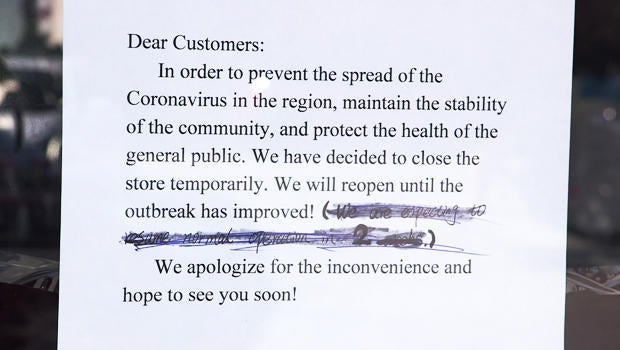
store-closed-sign-620.jpg A store's closing notice due to coronavirus. CBS News
According to the Bureau of Labor Statistics, just over half of all American workers (52.4%) are employed by small businesses (companies with 500 or fewer workers).

"Having an unexpected health crisis was not on any of these small businesses' radar," said Elissa Bard, vice-president at Community Capital New York, a nonprofit that helps small businesses get financing. "They don't have disaster contingency plans; they don't have Plan B."

CBS News business analyst Jill Schlesinger asked Bard, "What is it that they need right now?"

"They really need access to capital immediately.  They can't handle weeks or months of waiting for the financing to hit their bank account because they have bills to pay today, [or] yesterday, [and] employees to keep on their payroll if they possibly can."

Many are counting on the $350 billion in Small Business Administration loans that are part of the $2.2 trillion CARES Act.  Because of surging demand, lawmakers are working to add another $250 billion to the program.

"It's absolutely critical," said Dr. Germaine. "I don't see a lot of businesses surviving without that help. The problem is, how far is that help gonna go? Because that money's gonna go very quickly. Sometimes that's only two months' rent."

The government is offering $10,000 disaster loans, which are made directly by the Small Business Administration. There's also the Paycheck Protection Program to help companies retain workers and pay for some additional expenses, like rent and utilities, which can be forgiven. To access this money, owners have to go through banks.

It's been a frustrating process so far for many employers.

Brianna Banahan said, "We have not heard back from that application process. And then the second option is the payroll protection loan, so that, we actually haven't even been able to apply for that yet."

"I reached out to my bank, and they basically sent out an email saying that they don't really have anything in place yet," said Dr. Germaine. "They haven't gotten instruction."

"CBS Sunday Morning" reached out to the SBA about the logjam. They were unwilling to provide any official to offer an explanation.

The need is urgent:  According to the U.S. Chamber of Commerce, 24% percent of the country's small businesses say they will close permanently within two months without a financial lifeline.

Dr. Germaine speaks for many seeing tough times ahead: "I'm hoping I'll be able to keep it open. But you know, there's a big uncertainty there. So, it's unnerving, you know, 'cause I really don't know."

        For more info:

      Story produced by Alan Golds. Editor: Ed Givnish.

      More from Jill Schlesinger: 

© 2020 CBS Interactive Inc. All Rights Reserved.

Monday, April 13, 2020

no image

Soliton Announces New Launch Plan of Next Generation Acoustic Shockwave Product Due to COVID-19

HOUSTON, April 1, 2020 /PRNewswire/ -- Soliton, Inc., (Nasdaq: SOLY) ("Soliton" or the "Company"), a medical device company with a novel and proprietary platform technology, today provided an update on its business strategy and financial position in light of the current COVID-19 situation.

Soliton, Inc. is a medical device company with a novel and proprietary platform technology licensed from MD Anderson. The Company's first planned commercial product is designed to use rapid pulses of designed acoustic shockwaves in conjunction with existing lasers to accelerate the removal of unwanted tattoos (RAP device). In addition, higher energy versions of acoustic pulse devices ar   e in early stages of development for potential stand-alone treatment of cellulite and other indications. (PRNewsfoto/Soliton, Inc.)

"In light of the widespread impact of COVID-19, our view of the ideal launch window for our RAP device has naturally changed," commented Christopher Capelli, MD, founder, President and CEO of Soliton.  "Clearly, launching an aesthetic device during a national crisis such as the COVID-19 pandemic would be ill-advised.  Fortunately for us, though the delay of our limited market launch costs us some time, it has also had a valuable upside. Instead of launching our RAP device focused solely on tattoo removal in mid-2020, we are electing to delay that launch until the aesthetic and financial markets are demonstrating more stability.  In the meantime, we will remain highly focused on our regulatory pathway for cellulite reduction.  We now believe our initial launch could be timed appropriately to incorporate both tattoo and cellulite indications, subject to FDA clearance of the latter. We are all hopeful that this strategic shift allows sufficie nt time for our dermatology customers and the market in general to return to some sense of normalcy."

Soliton recently announced that we will be sharing the results from the 12-week follow-up of our pivotal cellulite study through the American Academy of Dermatology's virtual meeting expected to be held in the next 5 - 7 weeks. It is this data that will provide the clinical basis for our planned regulatory filing.  At this time, we do not anticipate a delay in our regulatory plans for the cellulite indication and plan to file our 510(k) in the second quarter of 2020.

As many dermatologist offices are currently closed, we are experiencing follow-up visit cancellations in our ongoing 26-week cellulite assessment and increased difficulty in executing the initiation of further clinical trials at sites around the country. While this will not impact the regulatory pathway for the initial cellulite indication, there is the expectation this will impact the timing of Soliton's planned additional hypertrophic scar proof-of-concept study and the longer-term 26-week follow-up visits in our cellulite pivotal study. Furthermore, it is possible this may extend the time required to file for additional, improved cellulite reduction claims with the FDA and for initial approvals of a hypertrophic scar indication that we may seek in the future.

Given the modification in our timeline and the instability in the financial markets, we have modified our spending plans and now expect our cash on hand to finance our operations to December 2020, assuming that we do not encounter any unforeseen costs or expenses.  We will modulate our launch timeline with early indicators of the recovery of the financial and aesthetic markets, with the objective of identifying an appropriate window of opportunity for a successful product debut.

Dr. Capelli concluded, "Despite the turmoil created by COVID-19, Soliton remains focused on executing it's 2020 milestones related to the regulatory pathway for cellulite and implementing new initiatives to drive continued business momentum. Although our commercialization timeline has been modified and we are facing incremental challenges, we remain committed to our long-term goal of providing our customers with the innovative Rapid Acoustic Pulse technology and generating long-term shareholder value. We appreciate for your continued interest and support in Soliton."

Join our more than 200K fans here to follow the Company: https://soly-investors.com

About Soliton, Inc.

Soliton, Inc. is a medical device company with a novel and proprietary platform technology licensed from MD Anderson. The Company's first FDA cleared commercial product will use rapid pulses of acoustic shockwaves as an accessory to lasers for the removal of unwanted tattoos. The Company is based in Houston, Texas, and is actively engaged in bringing the Rapid Acoustic Pulse ("RAP") device to the market. The Company believes this "Soliton" method has the potential to lower tattoo removal costs for patients, while increasing profitability to practitioners, compared to current laser removal methods.  Soliton is investigating potential additional capabilities of the RAP technology in clinical and preclinical testing, including the potential to improve the appearance of cellulite by creating mechanical stress at the cellular level and inducing significant collagen growth and the potential to treat keloid and hypertrophic scars by targeting the st iffened environment in the intracellular matrix. 

For more information about the Company, please visit:  https://www.soliton.com

Forward-Looking Statements

Some of the statements in this release are forward-looking statements within the meaning of Section 27A of the Securities Act of 1933, Section 21E of the Securities Exchange Act of 1934 and the Private Securities Litigation Reform Act of 1995, which involve risks and uncertainties. Forward-looking statements in this press release include, without limitation, the ability to execute a commercial launch of the RAP device for tattoo removal and cellulite, to execute on our 2020 regulatory plans, and to successfully fund the Company's operations through December 2020. These statements relate to future events, future expectations, plans and prospects. Although Soliton believes that the expectations reflected in such forward-looking statements are reasonable as of the date made, expectations may prove to have been materially different from the results expressed or implied by such forward-looking statements. Soliton has attempted to identify forward- looking statements by terminology including ''believes,'' ''estimates,'' ''anticipates,'' ''expects,'' ''plans,'' ''projects,'' ''intends,'' ''potential,'' ''may,'' ''could,'' ''might,'' ''will,'' ''should,'' ''approximately'' or other words that convey uncertainty of future events or outcomes to identify these forward-looking statements. These statements are only predictions and involve known and unknown risks, uncertainties, and other factors, including those discussed in our SEC filings, including under the heading "Item 1A. Risk Factors" in the Form 10-K for year ended December 31, 2019 we filed with the SEC and updated from time to time in our Form 10-Q filings and in our other public filings with the SEC. Any forward-looking statements contained in this release speak only as of its date. Soliton undertakes no obligation to update any forward-looking statements contained in this release to reflect events or circumstances occurring after its date or to reflect the occurrence of unanticipated events.

Cision View original content to download multimedia:https://www.prnewswire.com/news-releases/soliton-announces-new-launch-plan-of-next-generation-acoustic-shockwave-product-due-to-covid-19-301032921.html

SOURCE Soliton, Inc.